What Is a Sleep Score, and Should You Trust It?
Your watch turns eight hours of biology into a single number out of 100. Here’s what actually goes into it, what the sensors on your wrist can and can’t see, and why two devices score the same night differently.
You wake up, reach for your phone, and find that last night was a 74. Not terrible. Not good. You felt fine until you saw it.
Sleep scores are now on nearly every wearable, and almost nobody explains what the number is made of or how much confidence it deserves. This is that explanation — including the parts that are less flattering to the companies selling them, ours included.
What a sleep score actually is
A sleep score is a composite index: several separately-measured things about your night, weighted and combined into one number, usually out of 100. It is not a measurement. It is a summary of measurements, and the weighting is a design decision made by the company that built it.
That last point matters more than anything else in this article. There is no standards body for sleep scores. Every vendor picks its own inputs and its own weights. A 74 on one device and a 74 on another are not the same claim about your night — they are two companies’ opinions, expressed in the same units.
What goes into the number
The inputs vary, but nearly every sleep score is built from some combination of these:
| Input | What it means | Typical weight |
|---|---|---|
| Total sleep time | How long you were actually asleep, not how long you were in bed. | Heaviest — usually the single biggest factor. |
| Sleep efficiency | The share of your time in bed spent asleep. | High. |
| Wake episodes | How often, and for how long, you surfaced during the night. | High. |
| Time in each stage | The split between light, deep and REM sleep. | Moderate — and the least reliable input. |
| Timing and regularity | Whether you slept at a consistent time relative to your usual pattern. | Moderate. |
| Resting heart rate and HRV | Whether your body settled overnight the way it usually does. | Lower, but rising in newer devices. |
Read that list again and notice what it implies: a sleep score mostly rewards sleeping a long time without waking up. The exotic-sounding parts — stage balance, HRV recovery — usually move the number far less than simply being asleep for eight hours.
What your tracker can actually measure
Here is the part most sleep-score explainers skip.
The clinical standard for measuring sleep is polysomnography — an overnight study in a lab. It records electrical activity in your brain (EEG), your eye movements, and your muscle tone, among other signals. Sleep stages are defined by those brain and eye patterns. That is what a sleep stage physically is.
A wrist wearable has none of that. It has two sensors:
- An accelerometer — it detects movement. Lying still for a long stretch looks like sleep.
- An optical heart sensor — it shines light into your skin and reads changes in blood flow, producing heart rate and heart rate variability.
Some add skin temperature or blood oxygen. None of them read your brain. So when your watch tells you that you got 47 minutes of deep sleep, it did not observe deep sleep. It observed that you were still, your heart rate dropped into a particular range, and your heart rate variability behaved a certain way — and a model trained on people wired up in sleep labs concluded that this pattern usually means deep sleep.
This is not a scandal, and it doesn’t make the number useless. It means the number should be read as an estimate with error bars rather than a readout. The problem is that a clean two-digit score on a bright screen doesn’t look like an estimate. It looks like a fact.
Why two devices disagree about the same night
Wear two trackers to bed and you will very likely get two different scores. Three reasons, in order of how much they matter:
- 1Different formulas. The weights are proprietary. One vendor may treat six hours of sleep as a serious penalty; another may care more about how fragmented those six hours were.
- 2Different stage models. Each company trains its own classifier on its own data. Given identical raw signals, two models will draw the stage boundaries in different places.
- 3Different hardware and fit. Sensor placement, strap tightness, skin tone, tattoos and wrist hair all affect optical heart readings. A loose band genuinely produces worse data.
The practical consequence: never compare your score against someone else’s, or against your own on a different device. The only comparison that means anything is you, on the same device, over time.
What counts as a good sleep score?
Most devices use bands roughly like these:
| Score | Usually labelled | What it typically reflects |
|---|---|---|
| 90–100 | Excellent | Long, largely unbroken sleep at your usual time. |
| 80–89 | Good | A solid night with minor disruption. Most good nights land here. |
| 70–79 | Fair | Short, fragmented, or at an unusual time. |
| Below 70 | Poor | Meaningfully short or broken sleep — or a bad reading. |
Bands vary by manufacturer. Check what your own device considers normal for you rather than assuming these thresholds.
A more useful frame than the bands: most healthy adults sleeping normally score in the 80s. Consistently sitting in the 90s usually means you are sleeping unusually long, not unusually well. And a scattering of low nights in an otherwise steady month is ordinary human sleep, not a problem to solve.
One night’s score is noise. Four weeks of scores is a signal. Treat the number the way you would treat a single weigh-in.
When to ignore your sleep score entirely
There is a documented failure mode here, and it has a name. In 2017 researchers writing in the Journal of Clinical Sleep Medicine described orthosomnia — patients whose determination to achieve perfect sleep-tracker numbers was making their sleep measurably worse. The anxiety about the score was more disruptive than whatever the score was reporting.
It is a genuine risk, and it is the direct consequence of designing a wellness feature like a video game. Some practical guardrails:
- If you feel rested, you slept well. Your own experience outranks the estimate. A poor score after a night you felt good about is a reason to distrust the score, not your body.
- Don’t check it first thing. Reading a low number before you’ve got out of bed reliably colours the whole day.
- Ignore any single night. Illness, alcohol, a hot room, a loose strap, a late meal — a hundred things move one night’s score.
- If it’s making you anxious, turn it off. A wellness feature that costs you sleep has failed at its only job.
- Persistent poor sleep is a doctor’s question, not a watch’s. No consumer wearable can diagnose a sleep disorder, and none should try. If you are consistently exhausted, snoring heavily, or waking gasping, that is a conversation with a clinician.
How to actually improve the number
Since total sleep time and continuity dominate most formulas, the things that move a sleep score are unglamorous and well-established:
- 1Keep a consistent schedule — same bedtime and wake time, weekends included. Regularity affects the score directly and everything else indirectly.
- 2Give yourself enough time in bed. Most adults need 7–9 hours. You cannot score well on six.
- 3Keep the room cool and dark. Both reduce the night wakings that the score penalises most.
- 4Move the last drink earlier. Alcohol helps you fall asleep and reliably fragments the second half of the night — which is exactly what the score measures.
- 5Cut caffeine after early afternoon. Its effects last far longer than most people assume.
- 6Wear the band correctly — snug, slightly above the wrist bone. Poor contact produces bad heart data, and bad heart data produces a bad score regardless of how you slept.
That last one is worth taking seriously. A meaningful share of inexplicably terrible sleep scores are strap problems, not sleep problems.
What we do differently
Two things, and we’d rather state them plainly than imply we’ve solved sleep science.
We interpret your night on your device. The signals from your wrist are read on your watch and phone rather than uploaded to a server for scoring. There is no central record of how you slept — which is a structural difference, not a policy promise.
We describe your night rather than grading it. A number is easy to obsess over and hard to act on. Tribe leans toward plain-language reflection — what changed, what it might relate to, what would help — because that is closer to how sleep actually improves. And there is no subscription attached to any of it.
What we cannot claim: that our stage estimates are meaningfully better than anyone else’s. Nobody wearing a wrist device is measuring brainwaves, and any company implying otherwise is overselling. What we can promise is that the reading stays yours — you can see exactly what we do and don’t collect, and erase all of it in one tap.
So: should you trust your sleep score? Trust it the way you’d trust a bathroom scale — useful over months, noisy day to day, and never the last word on how you actually feel.
Frequently asked questions
- What is a sleep score?
- A sleep score is a composite number, usually from 0 to 100, that summarises your night. It is built mainly from total sleep time, sleep efficiency, how often you woke, the split between sleep stages, and sometimes your resting heart rate and heart rate variability. Each manufacturer uses its own formula and weighting — there is no industry standard.
- What is a good sleep score?
- Most devices treat 90–100 as excellent, 80–89 as good, 70–79 as fair, and below 70 as poor. In practice most healthy adults sleeping normally score in the 80s. Consistently scoring in the 90s usually reflects sleeping unusually long rather than unusually well.
- How is a sleep score calculated?
- Your device records movement with an accelerometer and heart rate with an optical sensor, then a model estimates when you were asleep and which stage you were in. Those estimates are weighted — total sleep time and continuity usually count for the most — and combined into a single number. The exact weights are proprietary to each manufacturer.
- Are sleep scores accurate?
- Partly. Wrist wearables estimate when and how long you slept reasonably well, but sleep stages far less reliably, because stages are defined by brain activity and no wrist device measures brainwaves. Treat the score as an estimate with error bars, and rely on the trend across weeks rather than any single night.
- Why do two fitness trackers give different sleep scores?
- Because each company uses a different formula, a different sleep-staging model, and different hardware. Given identical raw signals, two models will place stage boundaries differently and weight the inputs differently. Only compare your score against your own history on the same device.
- Should I worry about a low sleep score?
- Not about a single one — illness, alcohol, a warm room or a loose strap can all cause it. If you feel rested, trust that over the number. Researchers have described "orthosomnia", where anxiety about achieving perfect sleep-tracker numbers actually worsens sleep. If poor sleep persists over weeks, or you snore heavily or wake gasping, speak to a doctor rather than a watch.
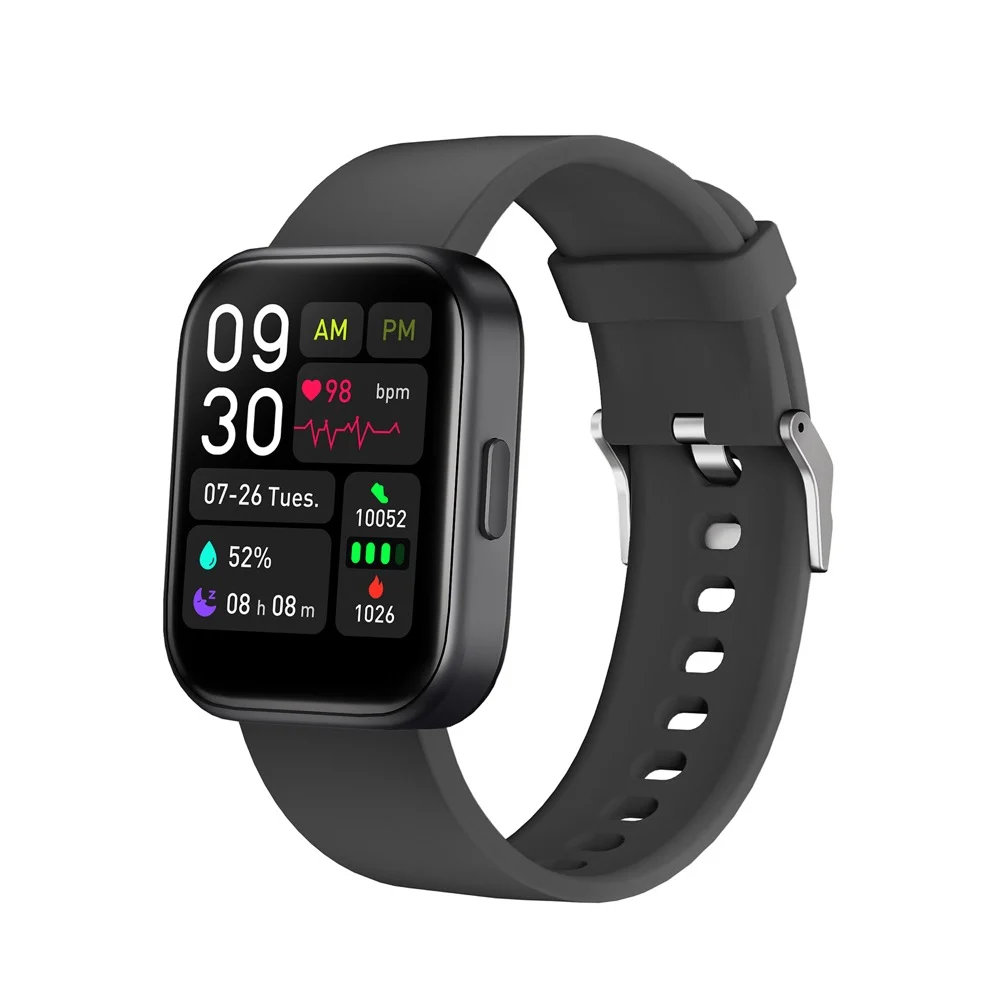
A sleep score you can actually see the workings of
The Tribe Watch reads your night on your wrist and explains it in plain language — no cloud upload, no subscription, and no pretending a wrist sensor is a sleep lab.
- Readings processed on your device, not our servers
- No advertising business — we sell watches, nothing else
- Erase everything with one tap, whenever you want
- No subscription for any tracking feature
Private by design. Yours by default.